
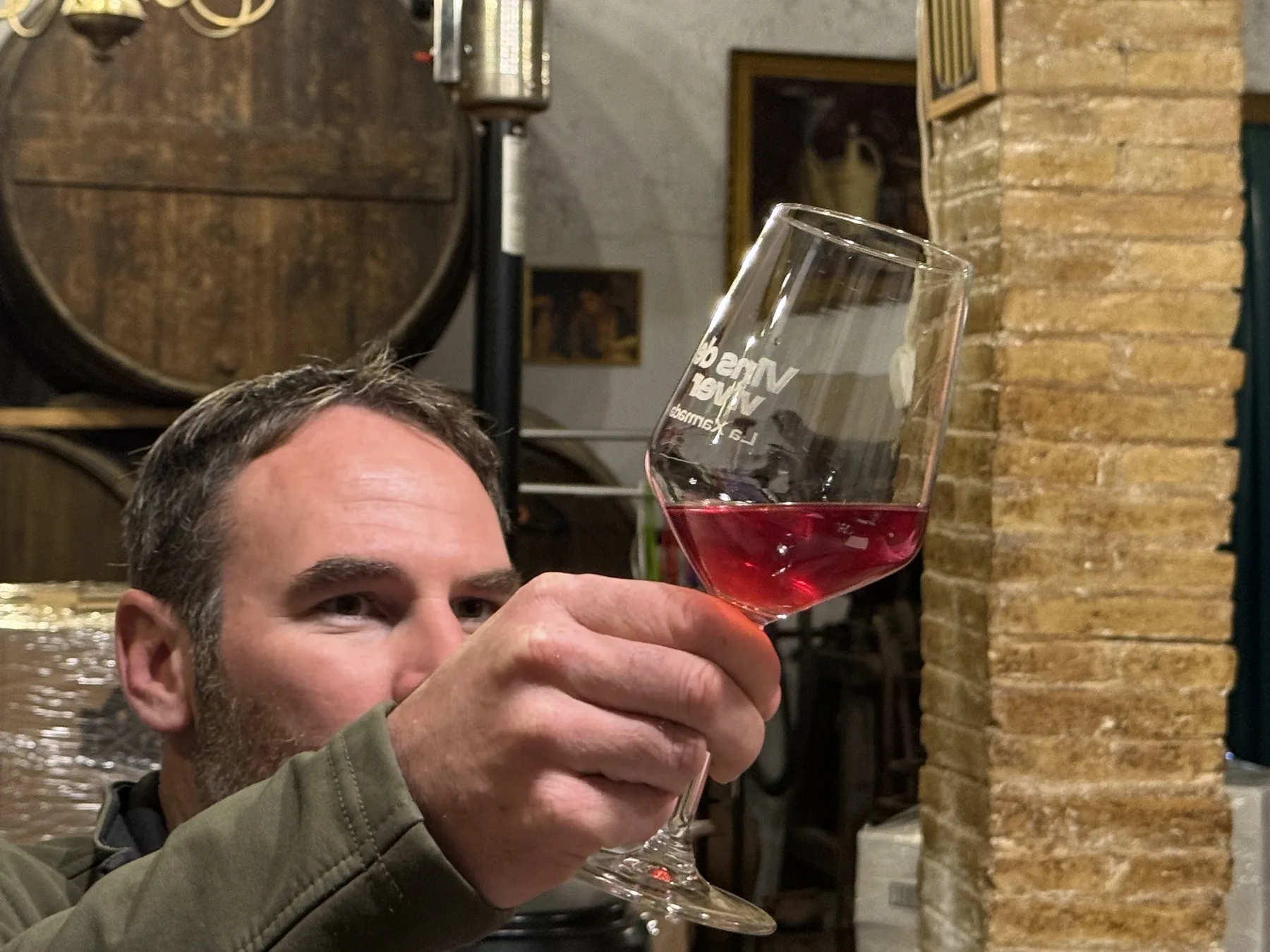
Merlot
Vilobí del Penedès
Dark cherry, plum, mid-palate flesh, soft tannin, and a dry-farmed biodynamic-regenerative origin story.
100 L / 50%
The grapes, their vineyards and the 2025 weather from 1 April to each harvest.
Merlot from Vilobí del Penedès and Garnatxa from Verdú, Lleida
Vilobí del Penedès
Dark cherry, plum, mid-palate flesh, soft tannin, and a dry-farmed biodynamic-regenerative origin story.
Verdú, Lleida
Ripe red fruit, glycerol, Mediterranean herbs, aromatic lift, and a cleaner fruit partner for the barrel.
The Garnatxa ripened at Verdú, inland; the Merlot at Vilobí del Penedès, nearer the coast and about 50 km away. Verdú swung 15.2 °C between day and night, Vilobí 11.4 °C. The table follows the Verdú vineyard on its own probes; the section below compares both vineyards.
| Measure | Verdú blockon-site probes | XEMA C7 Tàrrega6.2 km | What it does to the fruit |
|---|---|---|---|
| Night temperature, season mean minimumRespiration slows as the night cools, so the acid built during the day survives to dawn. Garnatxa loses acid faster than most red varieties, and cool nights are the only thing holding it. | 14.5 °CXEMA C7 Tàrrega 15.6 °C | 15.6 °C | Respiration slows as the night cools, so the acid built during the day survives to dawn. Garnatxa loses acid faster than most red varieties, and cool nights are the only thing holding it. |
| Nights at or above 20 °CWarm nights are what burn acid off. Across identical days the block recorded fewer than half the station’s count, and less than half of what the Merlot saw at Vilobí. | 16 of 171XEMA C7 Tàrrega 38 of 171 | 38 of 171 | Warm nights are what burn acid off. Across identical days the block recorded fewer than half the station’s count, and less than half of what the Merlot saw at Vilobí. |
| Day-to-night range, season meanThe Verdú swing is 3.8 °C wider than the Merlot’s at Vilobí. That difference is most of why the two halves taste unlike each other from the same vintage. | 15.2 °CXEMA C7 Tàrrega 13.1 °C | 13.1 °C | The Verdú swing is 3.8 °C wider than the Merlot’s at Vilobí. That difference is most of why the two halves taste unlike each other from the same vintage. |
| Days at or above 35 °CExtreme heat is regional and the block gets no shelter from it — the Merlot saw eight such days. Anthocyanin synthesis pauses above 35 °C, which is why the Verdú colour is built in the cool hours either side. | 34XEMA C7 Tàrrega 34 | 34 | Extreme heat is regional and the block gets no shelter from it — the Merlot saw eight such days. Anthocyanin synthesis pauses above 35 °C, which is why the Verdú colour is built in the cool hours either side. |
| Root zone at 15 cm, season meanRoots take up water and nitrogen freely below 25 °C and stop above 30 °C. At 15 cm the block did not reach 30 °C once in 2025. | 21.7 °CXEMA C7 Tàrrega no soil sensor | no soil sensor | Roots take up water and nitrogen freely below 25 °C and stop above 30 °C. At 15 cm the block did not reach 30 °C once in 2025. |
| Hours with the root zone above 25 °CA quarter of the season slows root uptake. At 15 cm the soil moves only 1.9 °C across a day, so just over half of those hours fall at night: once the root zone crosses 25 °C it stays there until the weather turns. | 1,043 of 4,104XEMA C7 Tàrrega — | — | A quarter of the season slows root uptake. At 15 cm the soil moves only 1.9 °C across a day, so just over half of those hours fall at night: once the root zone crosses 25 °C it stays there until the weather turns. |
| Plant-available water at 35 cmFull through flowering, drawn down after veraison. A mild deficit arriving that late thickens the skins, which is where a still red gets its tannin and its colour. | 62 % mean, 20 % lowXEMA C7 Tàrrega — | — | Full through flowering, drawn down after veraison. A mild deficit arriving that late thickens the skins, which is where a still red gets its tannin and its colour. |
| Relative humidity at nightVerdú nights are ten points drier than Vilobí’s 84.5 %. The skins stay sound through a long hang, which is what makes the later picking possible. | no hygrometerXEMA C7 Tàrrega 74 % | 74 % | Verdú nights are ten points drier than Vilobí’s 84.5 %. The skins stay sound through a long hang, which is what makes the later picking possible. |
| Hours at or above 90 % humidityBotrytis needs sustained wetness on the skin. The Vilobí Merlot sat under that condition for 797 hours, and its picking date was set by it rather than by sugar. | —XEMA C7 Tàrrega 589 of 4,104 | 589 of 4,104 | Botrytis needs sustained wetness on the skin. The Vilobí Merlot sat under that condition for 797 hours, and its picking date was set by it rather than by sugar. |
| Rain in the 30 days before pickingEnough to carry the vines to the end without dilution. The Merlot took 39.9 mm over its own last month, and came in with a softer acid line as a result. | —XEMA C7 Tàrrega 21.0 mm | 21.0 mm | Enough to carry the vines to the end without dilution. The Merlot took 39.9 mm over its own last month, and came in with a softer acid line as a result. |
Block figures are the on-site probes at 15-minute resolution: air temperature, and soil temperature and plant-available water at 15, 35 and 50 cm. The probes carry no hygrometer and no rain gauge, so humidity and rainfall come from XEMA station C7 at Tàrrega, 6.2 km away, at half-hourly resolution. Day and night are taken from solar elevation, not from a light sensor. The season runs from 1 April to the day the fruit was picked. Bars show shares and percentages; temperatures sit on one 0–40 °C scale.
In June, Verdú averaged 29.2 / 21.4°C by day and night against 27.7 / 19.9°C at Vilobí. Night humidity was 61.2% at Verdú and 79.1% at Vilobí; in August it was 62.9% and 81.6%. The Vilobí Merlot then received 39.9 mm of rain in its final 30 days, against 21.0 mm for Verdú Garnatxa.
Merlot
Vilobí del Penedès · XEMA W4
Harvest 21 Sept
1 April to harvest
11-day dry spell
MJ/m², 1 April to harvest
174 observed days
8 days at or above 35°C
Garnatxa
Verdú · XEMA C7
Harvest 18 Sept
1 April to harvest
21-day dry spell
MJ/m², 1 April to harvest
171 observed days
34 days at or above 35°C
Monthly XEMA accumulation. September ends on each lot's harvest date.
Monthly means; September ends at each lot's harvest date.
Mean air temperature during calculated daylight and night-time periods.
Mean relative humidity during calculated daylight and night-time periods.
Observed half-hourly XEMA temperature, humidity, precipitation and global solar irradiance from 1 April to harvest; 99.9% coverage. Irradiance in W/m² is integrated as MJ/m². A high-solar day reaches at least 65% of daily extraterrestrial irradiation. Station observations describe regional exposure at municipality precision: W4 Vilafranca del Penedès–la Granada (3.4 km); C7 Tàrrega (6.2 km).