Vin-Q
Dues Terres · 2025

Constructor and production route

The selected components, production controls and dated stages used for this wine.

Dues Terres · vintage timeline

How this wine was made

4 recorded decisions in order, each at its Vin-Q Method gate. Open any step for the measured parameter, the alternative that was discarded, and the consequence in the glass.

  1. G1
    Step 1 of 4measured

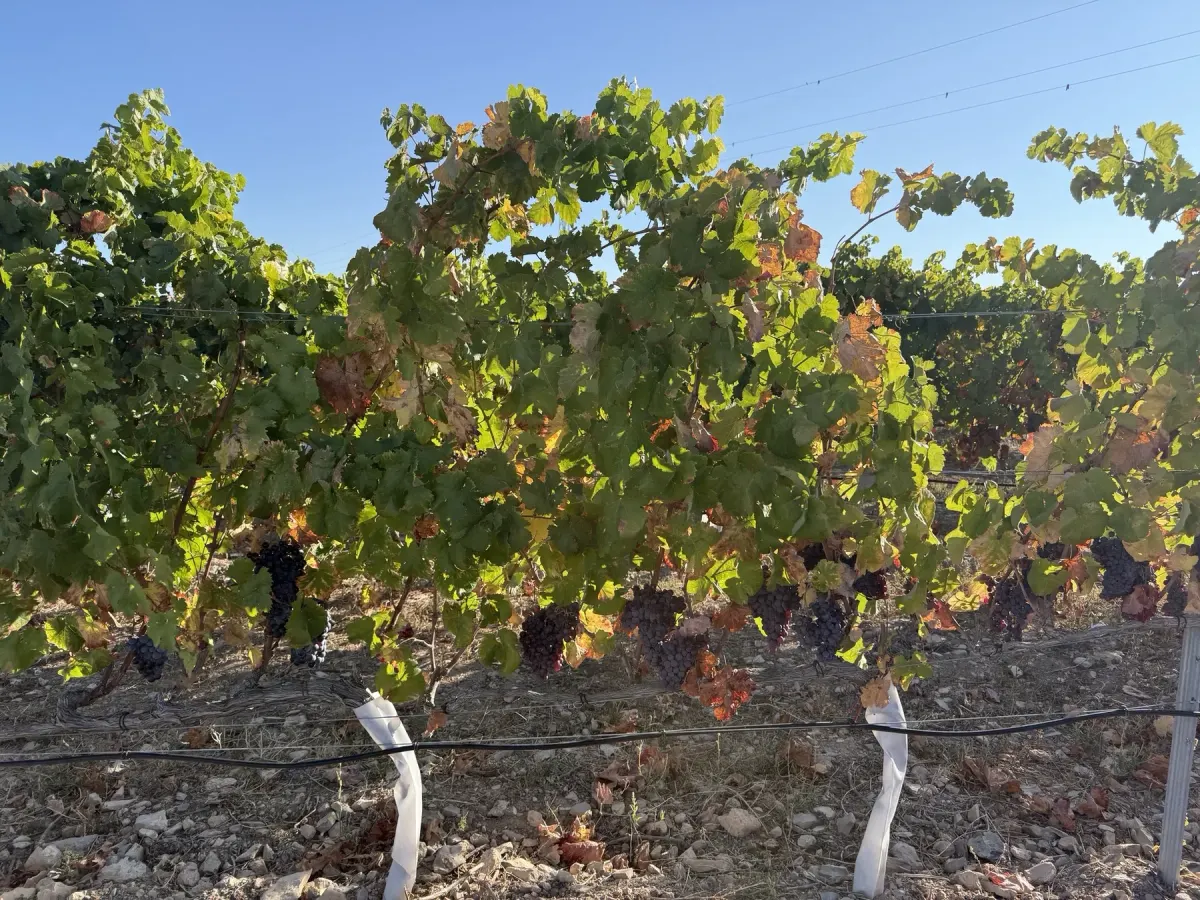
    Bi-Regional Sourcing

    Functional Terroir Blend

    Harvested before 20 September 2025calculated

    The Garnatxa sheet opens on 20 September 2025 and the Merlot on 26 September; both follow their harvest.

    100L Vilobí Merlot (50%) + 100L Verdú Garnatxa (50%)

    Why this way
    The verified decision

    Penedès coastal dry-farmed clay provides contour; inland continental limestone gives vibrancy.

    The discarded path

    Monovarietal Merlot or Garnatxa was rejected to achieve food-pairing balance.

    In the glass

    Merlot delivers dark plum flesh & soft tannin; Garnatxa injects wild herb lift and glycerol.

    Merlot and Garnatxa followed as two separate source parcels.
    Merlot and Garnatxa followed as two separate source parcels.
  2. G7
    Step 2 of 4calculated

    Volatile Acidity & Acid Shield

    Pre-Blend Chemical Gate

    Fermentation 20 September – 1 October 2025measured

    Cellar CONTROL DE FERMENTACIÓ sheets for the Garnatxa and Merlot components.

    Cooling <8°C, target pH 3.25, and single 40 ppm SO2 addition at blending

    Why this way
    The verified decision

    A pH of 3.25 triples the active molecular fraction of SO2, maximizing microbial defense with minimal dose.

    The discarded path

    Uncontrolled warm blending or high chemical sulfur dosing was rejected.

    In the glass

    Merlot VA (1.45 g/L) safely integrated to 0.96 g/L calculated blend threshold.

    Cooled and blended under a single controlled SO2 addition.
  3. G8
    Step 3 of 4target

    Neutral Oak Micro-Oxygenation

    Vessel & Texture Kinetics

    date not recorded

    Aging in exhausted 225L neutral oak barrel without new wood extraction

    Why this way
    The verified decision

    Neutral wood pores allow minute, steady oxygen ingress (~20 mg/L/year) binding anthocyanins and tannins.

    The discarded path

    New French/American oak or stainless steel reduction was rejected.

    In the glass

    Natural tannin polymerization without masking grape identity behind vanilla or toast flavors.

    Aged in exhausted neutral oak, without new-wood extraction.
    Aged in exhausted neutral oak, without new-wood extraction.
  4. G8
    Step 4 of 4target

    Weekly Topping & Headspace Control

    Maturation & Release Gate

    Release December 2026declared

    Stated in the process file.

    Zero headspace maintenance; weekly topping log + continuous VA and sensory tracking

    Why this way
    The verified decision

    Full barrel fill eliminates the oxygen-air interface, suppressing acetic film yeast growth.

    The discarded path

    Leaving barrel ullage or applying aggressive fining agents was prohibited.

    In the glass

    Clean, savory, energetic red wine with silky mouthfeel and zero mousy or oxidized faults.

    Weekly topping and continuous sensory tracking before release.
    Weekly topping and continuous sensory tracking before release.
Control de fermentació

Fermentation trace · Garnatxa

measured
Temperature18–25 °CDensity1084 → 1010 g/L
27221610901047100420 Sept23 Sept26 Sept28 Sept30 Sept

Started at 18 °C and rose to 25 °C as fermentation established. Density fell from 1084 to 1010 g/L over eleven days.

Cellar CONTROL DE FERMENTACIÓ sheet, 20 September to 1 October 2025. No reading was entered for 25 September. The 21 September density was a recording error and has been withdrawn rather than corrected.

Production controls

Controls specific to this wine

01

Merlot plus Garnatxa, by function

Merlot supplies dark fruit, mid-palate flesh, and soft tannin. Garnatxa widens the aroma toward red fruit, herbs, glycerol, and Mediterranean warmth.

02

Acid Shield before the blend

Both components are cooled below 8 deg C and adjusted to pH 3.25 before blending, giving the wine brightness and improving the effect of the single SO2 addition.

03

Neutral oak as an oxygen vessel

The barrel is not used for vanilla or toast. It gives slow oxygen transfer so tannins polymerize and the two origins integrate over 9 months.

04

Weekly topping as quality control

The barrel must stay full. Weekly topping limits headspace and keeps the wine in the intended savory, food-led register.